


Modern Medicine and International Cooperation
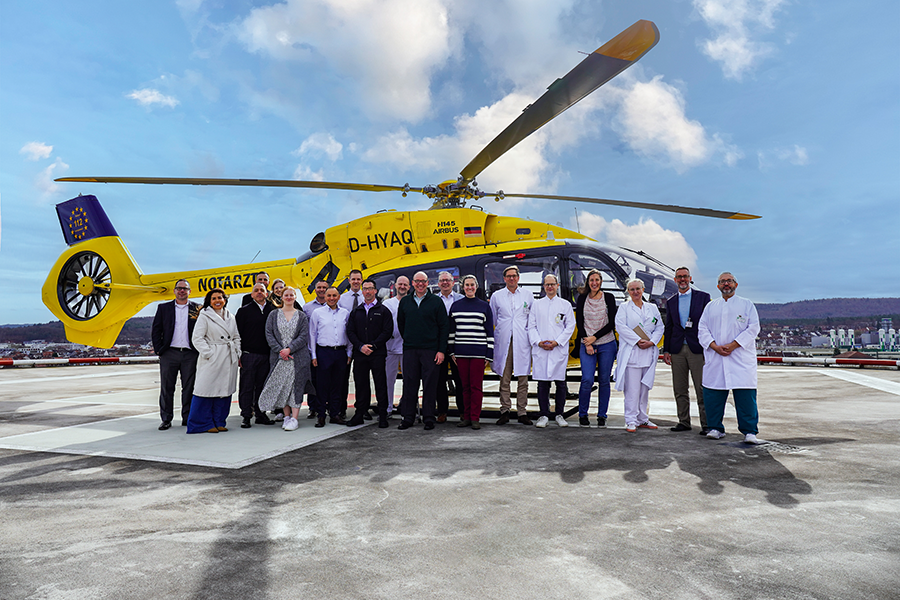
Foto: Westpfalz-Klinikum
The Westpfalz-Klinikum is one of the largest hospitals in Rhineland-Palatinate, and with its locations in Kaiserslautern, Kusel, Kirchheimbolanden, and Rockenhausen, it serves as a central pillar of regional healthcare. With around 4,000 employees and 1,370 beds across 40 clinics, departments, and institutes, the hospital is also one of the region’s most important employers.
As part of the Leadership Connect Program, we had the opportunity to visit the Kaiserslautern clinic: With over 25 highly specialized departments—ranging from neurosurgery and cardiac surgery to oncology—the hospital, as a tertiary care facility, covers virtually the entire spectrum of modern medicine. We were even able to take a tour of the facility and got a glimpse of the intensive care unit, the delivery room, and the pediatric ward, among other areas. A real highlight was visiting the hospital’s helipad and watching the rescue helicopter land up close!
A particular strength of Westpfalz-Klinikum is its close international collaborations. It has strong ties with the Landstuhl Regional Medical Center (LRMC) and is a reliable partner in caring for American patients. Regular exchanges take place regarding the coordination of emergency care capacity, for example. The hospital also provided vital medical and logistical support during exceptional situations such as the evacuation efforts following the 2021 Afghanistan crisis.
The meeting between American leaders and representatives from the medical and surgical nursing communities clearly showed that, despite their systems being different (medical and military), the challenges they face are often more similar than expected.
One of the topics of discussion was the standardisation of structures. The construction of the new US military hospital in Weilerbach illustrates just how challenging it is to reconcile different sets of regulations — in this case, German, European and US regulations. However, the goal is clear: to create a healthcare system that is as uniform and efficient as possible. Interestingly, even within the U.S. military — for example, between the Army, Air Force, and Navy — there are different structures and standards.
The topic of artificial intelligence also sparked intense discussions. Its use is viewed with particular scepticism, especially in sensitive fields such as medicine and the military. One thing is clear: AI can provide valuable support in time-consuming processes and, to some extent, in patient communication. In radiology, for instance, we can already see how valuable AI can be, as it analyses images in a matter of seconds, thereby helping to save precious time. Nevertheless, AI remains a tool, and responsibility still lies with humans. It will therefore be crucial to train professionals so that they can use AI competently and effectively, and question its applications. Despite all technological advancements, one thing remains true: humanity and empathy cannot be replaced by machines.
One of the biggest shared challenges is the shortage of skilled workers. Both the medical and military sectors are lacking young talent. The Westpfalz-Klinikum is therefore placing greater emphasis on training at its in-house training and continuing education centre. The planned Medical School Kaiserslautern, in cooperation with Semmelweis University, will also play a key role in retaining healthcare professionals in the region in the long term.
But beyond training and recruitment, retention is also a key concern. In a 24/7 industry such as healthcare, achieving a traditional work-life balance can be challenging, particularly when it comes to balancing childcare with shift work. Pilots in the U.S. Air Force are also familiar with this challenge. This makes creating a work culture that makes people want to stay all the more important. Perhaps the term 'work-life harmony' best captures this: a demanding profession that is challenging yet fulfilling.